How to Choose the Right Silicone O Rings for Your Applications?
Choosing the right Silicone O Rings for your projects can feel overwhelming. There are many factors to consider. These small, circular seals play a crucial role in various applications, from plumbing to machinery. Selecting the incorrect size or material can lead to costly leaks and failures.
Silicone O Rings offer flexibility and durability. They resist extreme temperatures and environmental factors. Yet, not all silicone is created equal. Understanding your specific needs is essential. Will your O Rings face chemicals? Or will they work in high-pressure settings? These questions matter.
Mistakes happen. You might overlook the durometer rating or material compatibility. Such oversights can be expensive and frustrating. Therefore, a thoughtful approach to choosing the right Silicone O Rings is vital. By considering your application carefully, you can avoid potential pitfalls and ensure optimal performance.
Understanding Silicone O Rings: Types and Specifications
Silicone O rings are versatile sealing solutions. They come in various types. Understanding their specifications is crucial for proper application. There are different durometers available. Durometer measures hardness. A lower number indicates a softer material. A higher number means a firmer ring. Choose wisely based on your needs.
Tip: Always check the temperature range. Silicone O rings can withstand extreme temperatures. However, not all types are suitable for every condition. Know your environment before selecting an O ring. Consider factors like pressure and exposure to chemicals.
Some O rings are better for specific tasks. A smooth surface may be ideal for low friction applications. Others might need added texture for gripping. Each type offers unique benefits. However, mismatching can lead to failure. It's essential to evaluate your application carefully before making a decision.
Factors to Consider When Choosing Silicone O Rings
When selecting silicone O rings, several factors play a crucial role in achieving optimal performance. The first consideration is the temperature range. Silicone O rings can handle temperatures ranging from -60°C to 200°C. However, specific applications may require different temperature tolerances. Materials may degrade if temperatures exceed recommended limits.
Another important factor is the durometer, which measures hardness. Silicone O rings typically range from 30 to 80 Shore A. Softer O rings are more flexible but can wear out faster. A harder O ring offers durability but may not provide the best seal. Choosing the correct durometer is crucial for maintaining effective sealing under pressure.
Fluid compatibility is essential as well. Silicone O rings are often resistant to chemicals like water and oils. However, they can be vulnerable to some solvents and fuels. Data indicates that 20% of O ring failures are caused by chemical incompatibility. Therefore, understanding the environment in which the O ring will operate is vital for reliability. These factors must be carefully evaluated to ensure an O ring's long-term effectiveness in its application.
Applications of Silicone O Rings in Various Industries
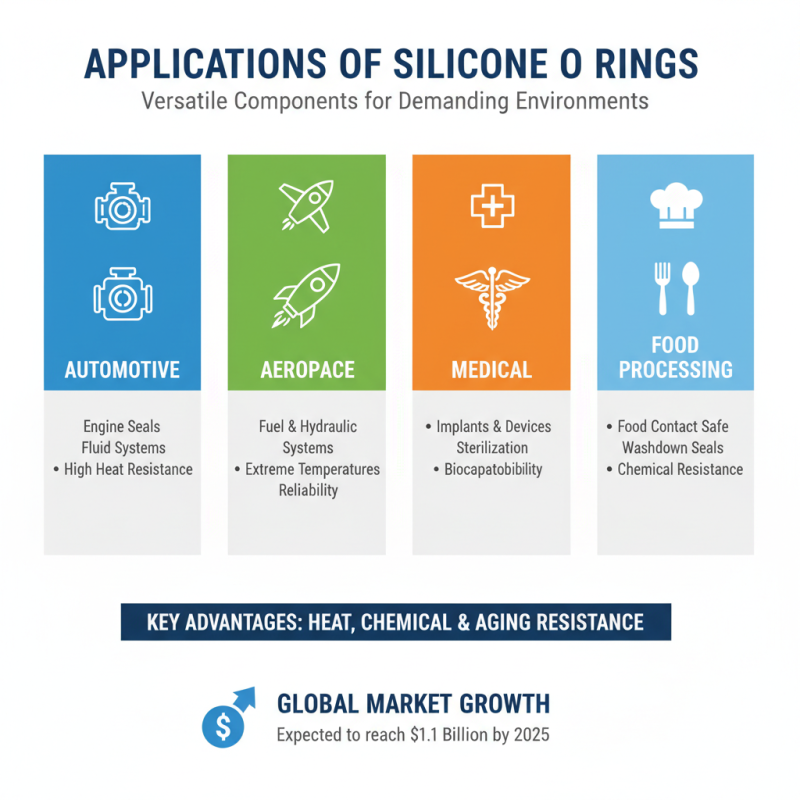
Silicone O rings are versatile components used across various industries. They play critical roles in automotive, aerospace, medical, and food processing sectors. Their ability to resist heat, chemicals, and aging makes them ideal for challenging environments. According to market research, the global silicone O ring market is expected to grow significantly, reaching $1.1 billion by 2025.
In the automotive sector, silicone O rings are employed in engines and fuel systems. These components withstand high temperatures and maintain integrity under pressure. In the aerospace industry, they are vital for sealing fuel tanks and ensuring safety during flight. A report indicates that about 80% of aerospace manufacturers use silicone O rings for their reliability and performance.
**Tips:** When choosing silicone O rings, consider temperature tolerance. The right material can extend product life. Look for certifications relevant to your industry, especially in medical applications. These ensure compliance with stringent health regulations. Keep in mind that a poor fit can lead to leakage, causing costly downtime. Regular inspections are essential for optimal performance.
How to Measure and Select the Right Size for O Rings
When selecting the right silicone O rings, size is crucial. Proper measurement ensures a secure fit, preventing leaks in various applications. The American Society for Testing and Materials (ASTM) recommends using calipers for accuracy. Measure the inner diameter (ID) first. Next, measure the cross-section diameter. This dual measurement allows for precision.
According to industry reports, incorrect sizing can lead to failures. Data shows that 30% of O ring failures are due to improper dimensions. Even a slight deviation can cause significant issues. For example, O rings that are too tight may wear out quickly. Conversely, those that are too loose can allow fluid leakage.
Considering different factors is essential. The material of the O ring also influences its performance. Silicone suits high-temperature applications, while other materials fit better in low-temperature scenarios. Think about the specific conditions where the O rings will be used. Will they face chemical exposure? Understanding the environment adds another layer to proper selection.
Maintenance and Care for Silicone O Rings in Use
Silicone O rings are vital in many applications. Proper maintenance is crucial for their durability and performance. Regular inspection can prevent failures that result from wear or environmental factors. Research indicates that about 30% of O ring failures are related to improper care.
When using silicone O rings, ensure they are kept clean. Dirt and debris can lead to premature wear. A mild detergent with water works well for cleaning. Rinse thoroughly to avoid contamination. Pay attention to the environment too. Extreme heat or cold can adversely affect silicone. Maintaining a stable temperature can improve O ring lifespan.
**Tip:** Store O rings in a cool, dry place away from direct sunlight. This helps prevent degradation. Use silicone-safe lubricants where necessary. Avoid petroleum-based products that can damage the silicone.
Over time, check for signs of wear, such as cracks or deformation. Minor defects may seem harmless, yet they can escalate quickly. Replacing O rings at the first sign of wear can prevent bigger issues. Regular monitoring is key to ensuring reliability in your applications.
How to Choose the Right Silicone O Rings for Your Applications? - Maintenance and Care for Silicone O Rings in Use
| Dimension |
Material Type |
Temperature Resistance (°C) |
Color Options |
Application Examples |
Maintenance Recommendations |
| 10 mm ID x 2 mm Thickness |
Standard Silicone |
-60 to 200 |
Translucent |
Plumbing, HVAC |
Clean regularly, avoid sharp tools |
| 20 mm ID x 3 mm Thickness |
High-Temperature Silicone |
-60 to 260 |
Red |
Food & Beverage, Automotive |
Inspect for wear, lubricate if necessary |
| 30 mm ID x 4 mm Thickness |
FDA-Approved Silicone |
-50 to 180 |
White |
Medical, Pharmaceutical |
Avoid extreme UV exposure, store properly |
| 40 mm ID x 5 mm Thickness |
Oil-Resistant Silicone |
-40 to 200 |
Black |
Industrial Equipment |
Check for oil degradation, replace if needed |