How to Choose Small O Rings for Global Sourcing?
Choosing Small O Rings for global sourcing requires more than comparing unit prices. A reliable decision connects material, size, pressure, temperature, certification, and supplier consistency. ISO 3601 defines important dimensional and quality requirements for O-rings, while Parker’s O-Ring Handbook explains how compression, gland design, and elastomer selection influence sealing performance. These references provide a practical engineering foundation.
Market research also deserves careful reading. The MarketsandMarkets Seals Market report identifies industrial automation, fluid handling, and automotive applications as major demand areas. Mordor Intelligence’s O-Ring Seals Market analysis highlights material development and regional manufacturing capacity. However, these reports usually cover broad categories. They may not describe the exact Small O Rings used in a compact valve or sensor housing. That gap matters.
Dr. Robert Flitney, author of The Sealing Handbook, states, “A seal is only as good as the system in which it operates.” His point remains highly relevant to international purchasing. A 2-millimeter cross-section can fail because of poor surface finish, incorrect squeeze, or incompatible cleaning fluid. A cheaper ring may also create hidden inspection and replacement costs.
A strong sourcing process should request drawings, material certificates, batch traceability, sample testing, and documented inspection limits. EPDM, NBR, FKM, and silicone behave differently under heat, oils, fuels, and outdoor exposure. The selection is rarely perfect on the first attempt. That is why prototype testing and supplier audits should come before large-volume orders. Global sourcing works best when engineering evidence supports every purchasing decision.
Define Small O Ring Specifications and Application Requirements
How to Choose Small O Rings for Global Sourcing?
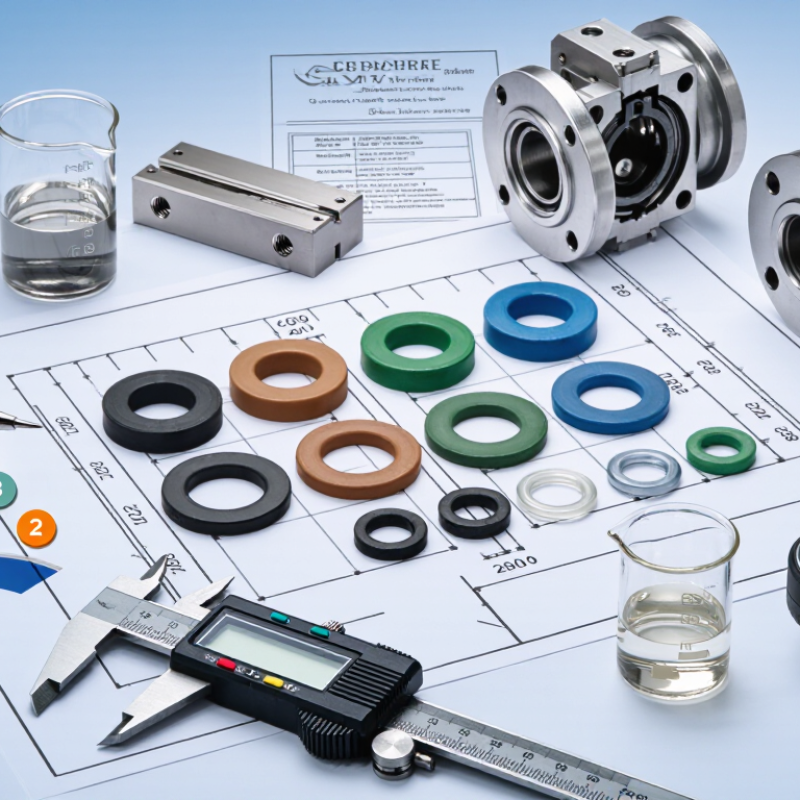
Define the application before comparing suppliers. Measure the groove, shaft, and sealing gap carefully. Record the inner diameter, cross-section, outer diameter, and dimensional tolerances. Small errors matter when the ring is only a few millimeters wide.
Specify the sealing conditions in plain terms. State whether the seal is static or dynamic. Describe the fluid, operating temperature, pressure, movement speed, and expected service life. Select the elastomer according to chemical compatibility, not price alone. Also define hardness, usually in Shore A, because excessive softness may cause extrusion. Check gland fill, squeeze, surface finish, and clearance. A neat specification can still be incomplete. I often recheck the groove drawing because one overlooked radius can change the sealing result.
Tips: Ask for material certificates, inspection records, and sample measurements. Confirm the applicable size standard and tolerance system before production. Request samples that match the final material and hardness. Test them with the real fluid and temperature when possible. Do not rely only on a supplier’s catalog image. Packaging also deserves attention; small rings can deform, mix, or collect dust during long-distance transport. Traceable labels reduce receiving mistakes. One practical warning: prototype performance may look excellent, yet repeated movement can reveal wear later. Allow time for that uncomfortable test.
Choose the Right Elastomer for Temperature, Chemicals, and Pressure
Small O Rings for Global Sourcing: Choose the Right Elastomer
A small O ring can fail quickly when its elastomer does not match the working environment. Temperature is the first filter. Nitrile suits many mineral oils and moderate heat, while fluorocarbon compounds handle higher temperatures and aggressive chemicals better. Ethylene propylene performs well with hot water and steam, but it may swell in petroleum fluids. Check the actual fluid, not only its trade description. ASTM D471 uses controlled immersion testing, commonly including 70 hours at a specified temperature, to measure volume and hardness changes. Request this test data before approving a supplier.
Pressure adds another risk. A soft compound may seal well at low pressure but extrude through a small clearance under load. ISO 3601 helps control O-ring dimensions, yet dimensions alone cannot confirm pressure performance. Review hardness, squeeze, gland fill, clearance, and pressure cycling together. ISO 815-1 compression-set testing is useful because permanent deformation can reveal poor recovery after extended heat exposure. Keep it practical. Ask for batch traceability, test temperature, exposure time, and measured results.
Global sourcing often rewards the lowest quoted price. That can be a false economy. A 2022 industry quality survey reported that material variation remains a frequent cause of seal defects, especially when specifications are incomplete. The figure deserves verification for each application. I would also question my own assumptions: laboratory fluid tests rarely reproduce every field contaminant. Define acceptance limits, inspect samples, and validate the O ring in the real assembly before scaling orders.
How to Choose Small O-Rings for Global Sourcing?
Choose the right elastomer for temperature, chemicals, and pressure.
NBR
Suitable for mineral oils, fuels, and general industrial sealing. Typical continuous service temperature: −30°C to 100°C.
EPDM
Strong choice for hot water, steam, weathering, and many acids or alkalis. Avoid petroleum-based oils. Typical range: −50°C to 150°C.
FKM
Performs well with oils, fuels, and elevated temperatures. Compatibility with hot water and steam can be limited. Typical range: −20°C to 200°C.
Silicone
Handles wide temperature swings, ozone, and weathering, but has lower resistance to fuels, abrasion, and high-pressure extrusion. Typical range: −60°C to 200°C.
PTFE
Provides very broad chemical resistance and high-temperature capability. Its low elasticity and tendency to creep require careful gland and pressure design. Typical range: −200°C to 260°C.
The temperature values show typical continuous service limits and may vary with compound formulation, media, compression, and duty cycle. O-ring pressure capability is not determined by elastomer choice alone; cross-section, hardness, gland clearance, surface finish, and backup-ring design must also be checked.
Match O Ring Size, Tolerances, and Sealing Performance
Choosing small O rings for global sourcing starts with dimensions, not price. In field evaluations, a one-millimeter error can cause leakage or assembly damage. Match the ring inside diameter to the shaft and the cross-section to the groove. Check actual supplier dimensions, not only the nominal drawing. Record ID, cross-section, free-state size, and tolerance in one controlled specification. Measure twice.
Sealing performance depends on controlled squeeze. For a static seal, calculate radial or axial squeeze against the groove design. Too little squeeze allows pressure leakage. Too much squeeze increases friction and may cut the ring. Consider stretch, gland fill, pressure direction, and surface finish together. A smooth-looking groove may still contain sharp machining marks. I have seen samples pass bench testing, then fail after thermal cycling. That result is uncomfortable, but useful. Test at expected temperature, pressure, media, and assembly speed. Include low- and high-tolerance parts.
Material selection must follow actual exposure. Compare fluid compatibility, hardness, temperature range, compression set, and service life. Ask for batch traceability, inspection reports, and sample measurements. Keep approval samples sealed and labeled. Global shipments may face storage heat and long delays. Packaging should prevent deformation and contamination. A spreadsheet can still mislead when units are mixed. Use millimeters consistently. Before production approval, inspect several lots and repeat the seal test. Perfect assumptions rarely survive the first shipment.
Evaluate Suppliers, Quality Standards, and Global Certifications
How to Choose Small O Rings for Global Sourcing?
Small O rings demand more than a low unit price. Supplier evaluation should begin with production experience, material control, and transparent inspection records. Ask how the supplier controls compound mixing, molding temperature, flash, and dimensional variation. Request samples from several batches, not one attractive shipment. Ask for evidence.
A reliable supplier should explain its quality system clearly. ISO 9001 certification supports consistent process management, but it does not guarantee every O ring meets your application needs. Check the certificate scope, issuing body, expiry date, and manufacturing site. For automotive projects, IATF 16949 may be relevant. ISO 3601 can guide O-ring dimensions and tolerances. ASTM D2000 helps compare rubber performance, including hardness, tensile strength, and temperature resistance.
Global certifications require careful interpretation. Food-contact applications may need suitable regulatory documentation, such as FDA requirements or European food-contact compliance. Request a certificate of analysis, lot traceability, and testing data for each material grade. Confirm whether documents cover the exact compound, not merely the supplier’s general product range. Do not assume.
During audits, inspect storage conditions, packaging, and labeling. Excess heat, ozone, or sunlight can damage elastomers before installation. I once focused heavily on certificates and overlooked inconsistent packaging labels. That was a useful warning. Certification proves a system exists; regular testing shows whether the system works. Small details often expose larger sourcing risks.