How to Choose the Right Gas O Rings for Your Needs?
Choosing the right Gas O Rings can be a challenging task. An expert in the field, Dr. Michael Finch, once said, “The quality of Gas O Rings directly impacts your system’s performance.” This statement highlights the importance of selecting the appropriate rings for your specific application.
Gas O Rings are not just simple rubber circles; they are critical components in various industries. Your choice should depend on factors like temperature, pressure, and the type of gas involved. Understanding these elements is crucial. Many overlook these details, leading to unexpected failures or leaks.
When selecting Gas O Rings, pay attention to material properties and dimensions. It’s easy to make assumptions, but each application is unique. While some suppliers offer general-purpose rings, customizing your options could save time and resources. Mistakes can happen. Reflecting on past choices can lead to better decision-making in the future.
Identify the Specific Requirements for Your Application
Choosing the right gas O rings involves understanding your specific application. Start by identifying the temperature range your system will operate in. O rings have varying resistance to heat and cold. Some materials perform well under extreme conditions, while others fail quickly. Consider the pressure levels your application will experience. High-pressure situations necessitate stronger materials to prevent leaks.
Next, think about the fluid compatibility. Different materials react differently with gases and liquids. Make sure to select materials that can withstand chemical exposure without degrading. This can be tricky. Some users overlook this aspect, leading to early failures. Additionally, pay attention to the sizing. An incorrect size can lead to inadequate seals. Too tight, and the O ring may break; too loose, and it will not seal properly.
Many find the selection process confusing. It’s important to reflect on past experiences. Have you chosen materials that did not hold up? Learning from mistakes can lead to better choices. Take the time to assess all factors carefully. Your application deserves the right fit for optimal performance.
How to Choose the Right Gas O Rings for Your Needs? - Identify the Specific Requirements for Your Application
| Application |
Material |
Temperature Range (°C) |
Pressure Rating (psi) |
Durometer Hardness |
| Automotive Fuel Systems |
Nitrile Rubber (NBR) |
-40 to 100 |
150 |
70A |
| Hydraulic Systems |
Polyurethane (PU) |
-30 to 80 |
300 |
90A |
| Chemical Processing |
Fluoroelastomer (FKM) |
-20 to 200 |
250 |
75A |
| Food and Beverage |
Silicone |
-50 to 200 |
100 |
60A |
| Aerospace |
Ethylene Propylene Diene Monomer (EPDM) |
-40 to 150 |
220 |
70A |
Understand the Different Types of Gas O Rings Available
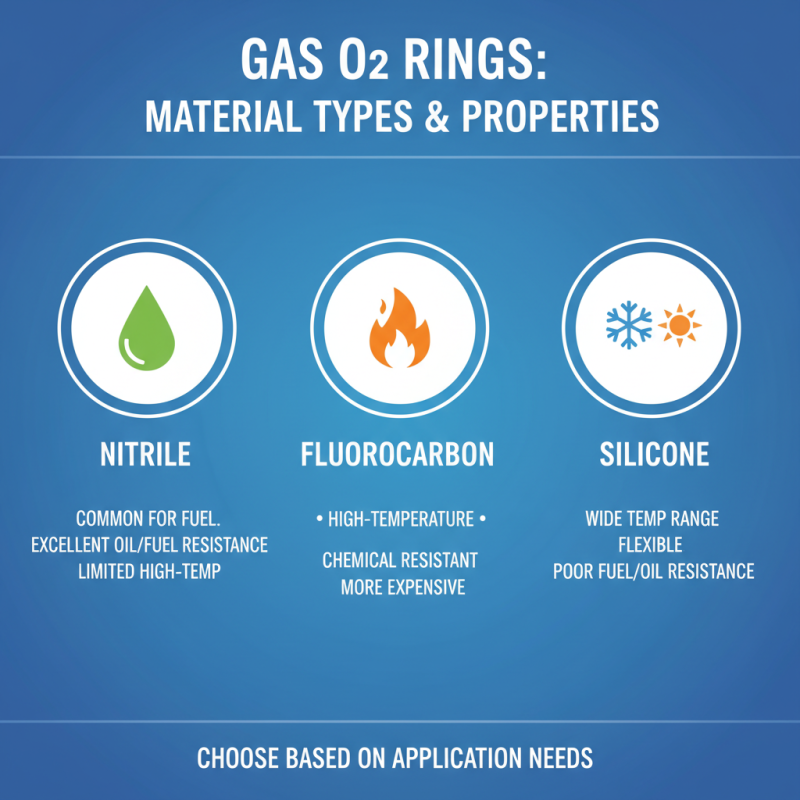
When choosing gas O rings, understanding the types available is essential. There are various materials, including nitrile, fluorocarbon, and silicone. Each material has unique properties that affect performance. Nitrile O rings are commonly used for fuel applications due to their excellent resistance to oil and fuel. However, they may not withstand extreme temperatures. Fluorocarbon O rings, on the other hand, handle high-temperature applications well but can be more expensive.
Consider the environment where the O rings will be used. For instance, a harsh chemical environment may require specific materials to ensure longevity. It's also vital to think about the size and design of the O ring. The wrong size can lead to leaks or failures that could be costly. A tight fit is crucial, but excessive pressure can degrade the O ring faster.
Reflecting on what you need can make a difference. Do you have the right tools to fit the O rings properly? Are you aware of the temperature ranges they will experience? Noticing these details can prevent issues down the road. Investing time in selection and understanding can pay off significantly.
Evaluate Material Compatibility with Gases Used
When selecting gas O rings, evaluating material compatibility is essential. Different gases react uniquely with specific materials. For instance, oxygen can degrade certain elastomers, while acidic gases may corrode others. This reaction can lead to failures in sealing applications, causing costly leaks or system failures.
The American Society for Testing and Materials (ASTM) reports that over 50% of material failures in gas applications result from improper material selection. Using high-performance elastomers, such as fluorocarbon or ethylene propylene diene monomer (EPDM), can offer resilience against a variety of gases. However, these materials may not be suitable for every application, leading users to overlook critical factors.
Compatibility charts are useful tools. They outline how different materials respond to specific gases. Regular testing and validation are keys to success. However, test conditions might differ from actual operating conditions, which can lead to unexpected results. Users often rely too heavily on standard charts without accounting for unique variables. Every application deserves careful consideration.
Consider Size and Dimensions for Proper Fit
Choosing the right gas O-rings requires a keen focus on size and dimensions. Accurate measurements are crucial for a proper fit. A report by the International Sealing Distribution Association indicates that approximately 60% of seal failures are due to incorrect sizing. This statistic highlights the importance of precision in selecting O-rings.
When considering size, the inner diameter and thickness of the O-ring matter greatly. Even a slight deviation can lead to leaks or seal failure. The industry standard is to reference the AS568A sizing chart, which provides specific measurements. However, it is worth noting that not all applications adhere strictly to these dimensions. Some custom applications may require unique sizes.
Remember, the material of the O-ring also plays a role. Certain materials perform better under specific temperatures and pressures. A 2022 study from the Rubber Manufacturers Association revealed that 30% of material selections failed due to environmental mismatches. It's essential to take the time to assess operating conditions thoroughly. This can prevent costly mistakes and ensure the longevity of your seals.
Assess Environmental Conditions and Their Impact on O Ring Performance
When selecting the right gas O rings, it’s crucial to assess environmental conditions. These conditions can significantly impact O ring performance. Temperature, pressure, and exposure to chemicals are all factors to consider. Research from the American Society of Mechanical Engineers shows that even slight deviations in temperature can reduce the lifespan of O rings by over 30%.
For instance, in high-temperature applications, O rings might harden or become brittle. This change affects the seal's integrity. At low temperatures, O rings might become too flexible and lose their sealing capabilities. A report from the Society of Petroleum Engineers notes that O rings exposed to extreme temperatures can fail within months if not properly rated for such environments.
Chemical exposure is another critical aspect. O rings made from materials like nitrile may degrade when exposed to certain oils or solvents. A study indicates that O rings can swell or shrink, impacting their fit within a groove. Proper material selection based on the chemical compatibility chart is necessary. Many users overlook this, leading to unexpected leaks and system failures. Always double-check the compatibility information before making a choice.